
by Barry Lee Pearson
Smithsonian Folkways Magazine
The Appalachian Mountains are only now beginning to be recognized as one of the primary incubators of African-American music, especially the blues tradition. Appalachian blues comes in a variety of styles— vaudeville blues, piano blues and boogie, string-band dance blues, guitar and harmonica-based down-home blues, ragtime blues, East Coast rhythm and blues, and so-called white mountain blues. Moreover, it includes such celebrated artists as Bessie Smith, Cripple Clarence Lofton, Cow Cow Davenport, Pinetop Smith, Josh White, Rev. Gary Davis, Jaybird Coleman, Luke Jordan, Dinah Washington, and James Brown. Why, with such an array of blues legends—the Empress of the blues, the Queen of the blues, and the Godfather of soul—has the region’s blues tradition received so little attention?
Part of the answer lies in the sheer size of the region. The Appalachian Mountain chain cuts diagonally across the Eastern United States from New York to Mississippi, with Appalachian counties in a full thirteen states. Another factor has to do with demographics. Common wisdom held that there wasn’t a sufficient black population in the mountains to sustain a viable blues tradition, in contrast with the cotton belt of the Deep South. One result of this bias was to associate the region almost exclusively with the country-music industry, which historically excluded black musical participation.
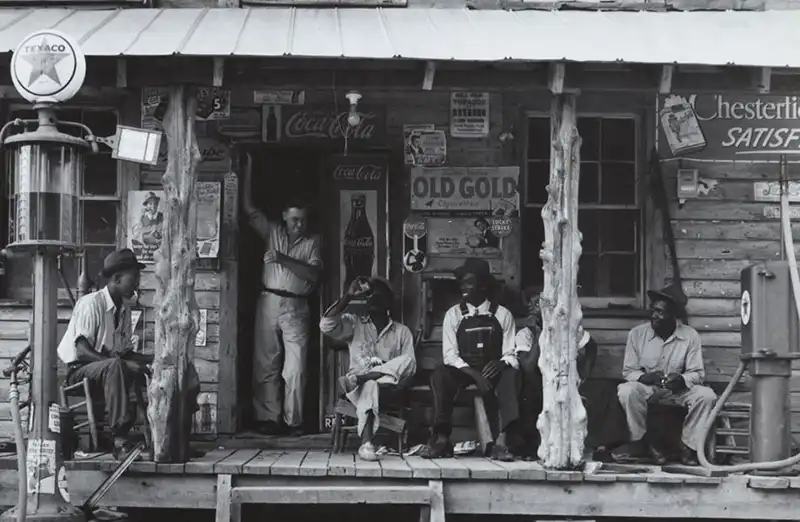
Photo by Dorothea Lange
A closer look at the region and its history reveals a more complicated story. First, in regard to demographics, the black population varied significantly from Alabama to West Virginia, and while whites may have outnumbered blacks across the region as a whole, the ratio was by no means uniform. Moreover, urban centers attracted substantial black populations, and blues thrived in Birmingham, Alabama, Spartanburg and Greenville, South Carolina, and Chattanooga, Knoxville and Kingsport, Tennessee. Finally, after the Civil War and during the expansion of roads and rail into the mountains, Southern blacks came in as workers, helping to open up Appalachia to broader cultural influences. Others were attracted by work in the coal mines of Kentucky and West Virginia. Among the workers were musicians, including professional musicians, who brought new techniques and served as musical role models. And whether they remained in the region or moved on, they left their musical signature.
Unfortunately, few of those artists had a chance to record, and they remain undocumented except in the memory of musicians who happened to have been interviewed. They recall a thriving blues tradition even though the discographical evidence appears to indicate the opposite. But the extent of recording is more a question of whether or not record companies wanted to expend the energy to seek out musicians in such relatively inaccessible environs and of what they chose to record once they got there.
A major exception to this was Victor’s 1927 Bristol Sessions, commonly called the “Big Bang of country music.” Two major stars, Mississippian Jimmie Rodgers and the Appalachian Virginian Carter Family, were found at this session. Although they recorded a lot of blues and other forms of black music, both were white, further reinforcing the tendency to put a white face on the genre “mountain blues.” But the sessions also produced recordings by several black artists: several sides by harmonica player El Watson and the Johnson Brothers, two of which were entitled blues, “Pot Licker Blues” and “Narrow Gauge Blues.” On November 2, 1928, Victor recorded two more blues sides by the duo Stephan Tarter and Harry Gay, “Brownie Blues” and “Unknown Blues.” A Columbia-Okeh field trip to Johnson City, Tennessee, on October 24, 1929, produced two blues by Ellis Williams, who played harmonica on “Buttermilk Blues” and “Smokey Blues.” Brunswick-Vocalion conducted several sessions in Knoxville, Tennessee, on August 28, 1929, recording two unissued blues by Odessa Canselor, two sides by songster Will Bennett, “Real Estate Blues” and the blues ballad “Railroad Bill,” and two songs by Leola Manning and Eugene Ballinger, “He Cares for Me” and “He Fans It.”
Read the rest of the article on the Smithsonian Folkways Magazine website.